Wednesday, March 23, 2016

The Holy Week Processions of León -- Faith and Optimism for the Future

At 81 years of age, Eduardo de Paz is known as a gentleman of quiet and profound faith.  The twelve brotherhoods he serves respect him as a leader, a source of knowledge, wisdom, and strength.  Over the years, he has witnessed decades of change: sometimes for better, sometimes worse.  


 Eduardo de Paz has been a member of the religious brotherhoods of Spain for 69 years.  He is a member of six brotherhoods in León, two in Malaga, two in Seville, one in Madrid and one in Saragosa.  He founded one of the most important brotherhoods in 1962. (You can click on photos in this blog for a larger view.)


“We are now in a bad time,” he says.  “There is a lack of religion.” 

Then, just as quickly, he expresses optimism. “In time, people will be more involved,” he pronounces.  “Of that, I am certain.”  He explains that the processions he has been a part of since the age of 12 are tools for teaching.  In centuries past, the gigantic religious floats (pasos) portraying the Biblical story of death and resurrection were the media of their time.  They told the story of Easter in a way that mere words could never express.  Today, he says, they continue to serve the same purpose.  They create an excitement and inspire people to participate; they introduce people to the brotherhoods and traditions.

Many hours are spent preparing, cleaning, repairing, and assembling pasos (floats) for the processions.


Those who become members of the brotherhoods treasure the experience.  A father often registers his son into the brotherhood upon his birth.  One of Eduardo’s son’s, Eduardo has achieved the honor of Hermano de Oro (Brother of Gold) for 50 years in the brotherhood.  The other son, José Luis will achieve the honor next year when he turns 50, also having a half century in the brotherhood.

 Eduardo's grandson, Jorge de Paz helps his grandfather into the robes that are unique to his brotherhood. Jorge was registered into the brotherhood upon his birth by his father, José Luis.


Eduardo poses in front of the Basilica of San Isodoro with Gonzalo González Cayón, the Abad (President) of another brotherhood, founded in 1572.


Eduardo, who founded the Cofradía de las Siete Palabras de Jesús en la Cruz (Brotherhood of the Seven Words of Jesus on the Cross) in 1962, says that the people of León take the processions very seriously.  Almost every family will have someone involved.  Thousands, young and old, men and women, will march in the processions. Those who participate will not only help bear a float or play a musical instrument, they will also have an opportunity to pray and become more involved in religion.  Spectators, too, continue to be drawn to the spectacle of a procession, with some drawing tens of thousands of onlookers.  Holy Week is the busiest time of the year in León.

 This paso being prepared for a procession is dedicated to Eduardo, who was the first Abad (President) of his brotherhood. He remain an honorary Abad.
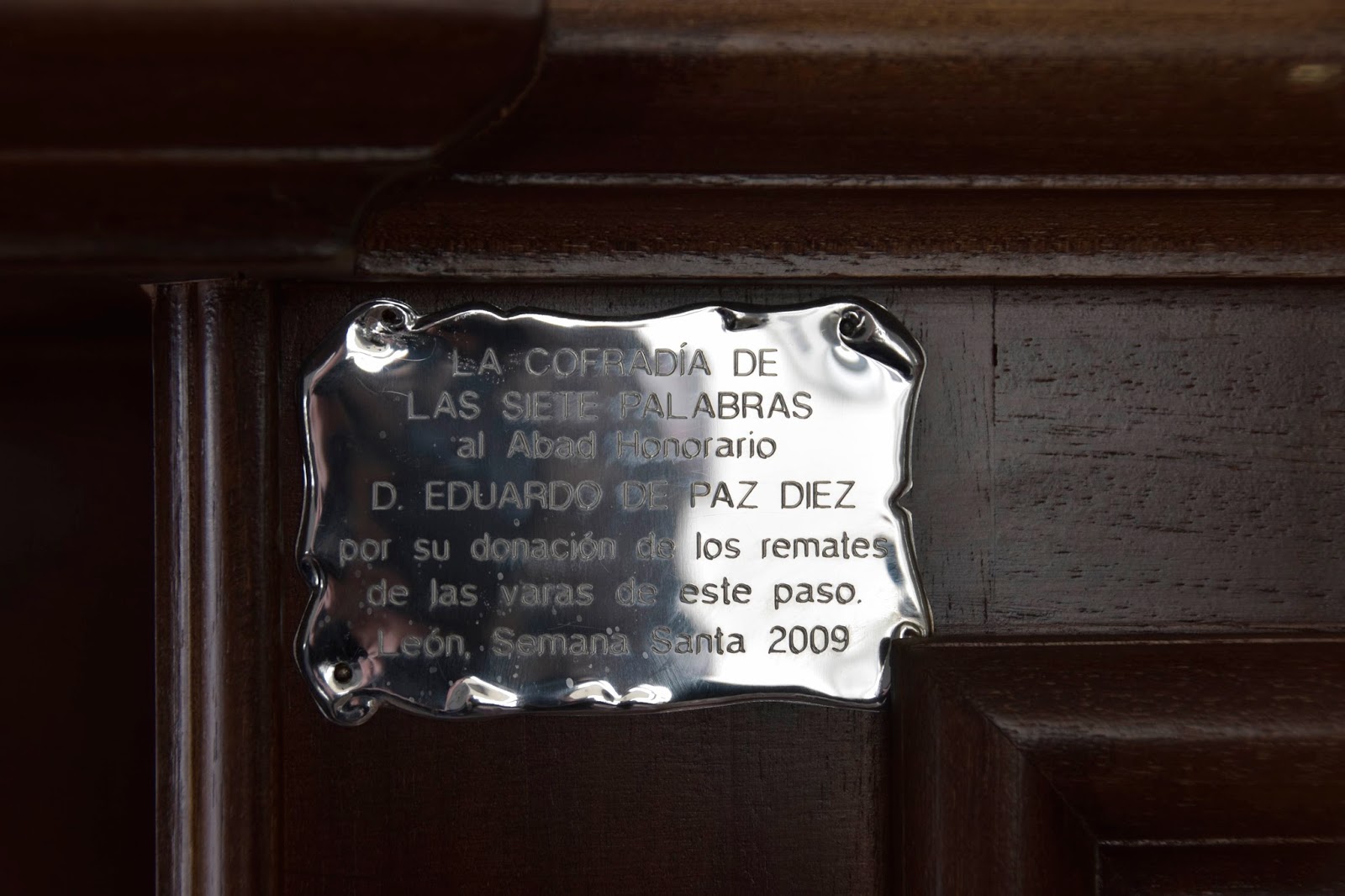
A plaque on the processions honors Eduardo for his service to the brotherhood.


Eduardo explains that the processions of Malaga and Seville are flashier, with many pasos displaying an excess of Baroque gilding, silver, and embellishments. Maybe, he says, this is why the processions of the South are better known. In the North, he declares, people are more serious and tend to favor less ornate pasos.  While still having its share of golden platforms and ostentation, the pasos of León are just as often made of beautifully carved wood without the excess of ornamentation.

Thirty-six processions are conducted over the ten days of la Semana Santa (Holy Week), some small with only a few hundred participants, others huge with many thousands actively involved.  When I asked Eduardo about the future, he was as optimistic as ever.  While the brotherhoods and processions evolve to meet the needs of their times, he does not see a time when processions will not continue to serve the faithful.  

A moonlight procession much as it might have looked one hundred years ago, and as it may appear one hundred years from now.


When I asked Eduardo if processions will still be flourishing in 100 years, he responded, “Certainly!”


I will continue reporting on Holy Week in León as the week progresses.

You can view my website at:  www.tombellart.com.

Tuesday, March 22, 2016

Holy Week in León -- Family, Tradition & Food

Holy Week in León is an event -- a family affair -- something that cannot be ignored. It is a week filled with ancient and modern traditions. Thousands, sometimes ten of thousands spill into the streets to witness some of the thirty-six processions conducted during the ten days of Holy Week. While some processions are small with only a few hundred participants, others are huge, with several thousand people marching through the streets in traditional costumes, some bearing gigantic religious floats (pasos), others playing musical instruments or simply playing their part by marching along.


Those who march in the processions are of all ages.  This younger participant
is on the way to the Church of Santa Nonia, where he will take part in the three hour
Procesión de la Pasión along with three thousand other marchers.  (You
can click on images for a larger view.)

Children proudly pose in front of the Church of Santa Nonia before the procession.


An hour before the procession, members of the brotherhood are already taking their places around the early 17th century paso.
A Lady prepares for the procession in the loft of the Church.
  
One of the three pasos dates to the 16th century.


 Crowds stand for more than an hour to view the three pasos leave the church.  Most processions, like this one are at night.


About two hours into the procession, the float still has about an hour to go before it returns to the Church of Santa Nonia.  The Baroque detail is typical of the 17th century.


Detail from the 17th century paso.  A cherub helps bear the weight of
Christ carrying the cross.


After a procession ends at ten or eleven at night, sometimes later, participants spill into the bars and restaurants for drinks and tapas. Bars in Spain are family-friendly, but are open through the wee hours of the morning.


A glass of wine accompanied by a cup of garlic soup as a tapa at the Camarote Madrid helps to warm one up after a procession.  Note the variety of olives in the background.  They are also excellent tapas.


As Holy Week in León progresses, I'll have more insight and more images during the upcoming days.  If you missed yesterday's overview of Holy Week in  León, you can find it here.

You can view my website at www.tombellart.com.


Monday, March 21, 2016

Preparing for Easter Week (Semana Santa) in León, Spain – An Unexpected Surprise of Tradition, Legos, Family, Pharmaceuticals, Food & Drink

This is an overview of Easter Week in León, Spain.  I will have much more information and photographs in subsequent posts as Holy Week progresses.

Maybe you’re familiar with the famous Holy Week activities of Seville or Malaga, or Antigua, Guatemala.  If so, you know that thousands gather to watch amazing religious processions as hundreds march through the streets, often in medieval habits or costumes carrying gigantic floats that depict the passion of Christ.  Many of the floats (pasos) date from the Baroque era and have been carried in the same procession year-after-year for centuries.  If you’ve seen one of these you’re very lucky.

Lesser known, but just as amazing are the processions of León.  It’s a small city in the north of Spain, maybe best known for its beautiful Gothic cathedral.

The Gothic cathedral in  León is known as one of the most beautiful in the world.  This photograph is from three years ago. My wife is in the middle.  She is with her cousin and his wife.  You can click on any of the photographs in this blog for a larger view.
León is also known as the best city in Spain for tapas, those generous portions of Spanish ham, or garlic soup, blood sausage, potato omelet, or a thousand other typical foods you get for free every time you order a drink in one of the city’s famous bars.  I’m not exaggerating when I say it’s worth coming to León just to wander the medieval streets of the barrio húmedo (drinking district) and have a cerveza (beer) or vino tinto (red wine) along with one of the many tapas that are given to you with the drink.  However, in the weeks around Easter, you should be aware that Limonada is the drink to have.  Every bar has its own version during the Easter season, but except for the examples that have a slice of lemon or orange, I can’t find any evidence of citrus.  It seems to be a mixture of red wine, in some cases a strong liquor, a bit of sugar, and who knows what else. It's much like sangría, but I think a bit stronger.  The locals warn you, don’t be fooled by its mild nature.  Two or three are plenty.


Limonada and tapas.  Three servings of limonada, an order of Russian salad and two pots of salmorejo. Salmorejo is similar to gazpacho, but thicker.  It is topped with bits of fried Spanish ham. The total cost was about US$5.00.


The Processions start on Friday the week before Easter, with as many as seven processions in a single day, everything ending on Easter Sunday.  They are sponsored by Catholic brotherhoods, many of them very ancient.  Young and old participate, and women also now actively take part in the processions.

A woman in traditional head-wear in a  Friday procession.

This Domingo de Ramos (Palm Sunday) procession is organized by the Brotherhood of Our Lord Jesus the Redeemer.  It stops in front of the Gothic cathedral as thousand watch. The float is typical of those in the Easter week processions.
At the time I took this photography, I didn't know its family significance.  My wife's Grandfather, my mother-in-law's father, Gonzalo de Paz purchased this Palm Sunday paso in the 1940s as President (Abad) of the Cofradía del Dulce Nombre de Jesús Nazareno (Brotherhood of the Sweet Name of Jesus of Nazareth). 


The modern mixes with the new, as Sponge Bob looks on as the procession rounds the Cathedral plaza.

It's amazing at how much pride the people of  León take in their Easter processions.  Store windows compete for the most amazing representation of Holy Week.

Pasos are represented by pharmaceutical packaging in the pharmacy window.

This is one of the most amazing Legos creations I've ever seen. In an embroidery shop window, hundreds of Legos people and objects depict a procession in the Plaza Mayor.


Legos spectators enjoy a procession.  Despite the umbrellas, a procession will be called off  if there is more than a small shower.  The pasos are generally made of wood and are very old.  They are easily damaged by water.


The Legos scenes are extremely detailed.


The Legos window is very popular and draws many passersby unable to resist the creativity and detail of the scene.

This is my first blog post on Easter week in León.  More will be coming in the days ahead.

You can view my website at www.tombellart.com.

Thursday, December 31, 2015

Mystery of the Miracle Frisbee


This is a true story that happened on New Year's Eve of 2011. I originally published it in January of 2012.  I've republished it on New Year's Eve over the past few years because it's true, possibly inspirational, and I think you'll find it amazing.

The story below is absolutely true.  My family and I were there and experienced this first-hand.  It is not the type of material you find in my typical blog entry.  However, it is too good not to share.  Please post your thoughts at the bottom of this page.  Share this with anyone you think might enjoy it or get caught up in the mystery.

What do you call it when something beyond understanding occurs -- something that defies all odds? Is it a paranormal event?  A coincidence of unimaginable proportions?  Magic?  Or is it a miracle? And what if you can prove to yourself and others that it really happened because you were there and you took photographs!  This incident concerns nothing more elaborate than a Frisbee, but it is mystifying, nevertheless.

My wife’s family is from Guatemala.  My wife, our two children, and I live in Illinois and sometimes visit her family in Central America over the holidays.  This year, we, along with most of my wife’s large family, spent the week after Christmas at my sister-in-law’s beach house on the Pacific coast of Guatemala.

My daughter practicing her gymnastics on the black sand beach.
Every day, my wife’s younger brother, Gonzalo, would run out to the volcanic black sand with his Frisbee and toss it along the beach or over the waves and let the wind return it to him.  Two days before New Year’s, as my children and some of the cousins played on the beach, I took my camera and photographed him exercising with the white disc.
My brother-in-law, Gonzalo, running on the beach with his Frisbee.  Notice the design of the Frisbee on the inset.
Later in the evening, my wife, Maria, and I; Gonzalo and his wife, Marta Yolanda; and the children went down to the beach to catch the sunset.  The children built a castle in the sand.  Maria, Marta Yolanda, and I stood and watched the progress of the castle building activities, while Gonzalo launched his Frisbee toward the waves.  I took several photographs.  Several times, the Frisbee landed on the water and was returned in the waves.  Everyone was having a great time, until my brother-in-law made a bad toss.  He groaned as the Frisbee went into the waves and was not immediately returned on the surf.

The children made a sand castle, while my brother-in-law (far right) played with his Frisbee.


“It’s gone,” he said.

“Give it a minute, and maybe the waves will bring it back,” I suggested.

“No, Tom, I don’t think it’s coming back,” he sighed, as we all peered into the dark waves, hoping that he might be wrong.

After another half minute, I pointed into the surf as a white object came into view. 
“There it is,” I yelled.  The Frisbee washed directly to my wife’s feet and hit her on the shins.  She walked over and handed it to her brother.

He took the disc happily, but after only a moment said, “This isn’t my Frisbee.”

We all looked at him. 

“My Frisbee was red on top.   This one’s black.”

“That has to be your Frisbee,” I said.

“Maybe it had a sticker on it that came off in the water,” my wife suggested.

“No,” Gonzalo insisted.  “Mine was a pure white.  This is pearl colored.”

“That has to be your Frisbee,” I said.   “If it’s not, whose is it?  And how is it possible that it washed up at our feet just as we were looking for a Frisbee?  How many times have you ever had a Frisbee wash up at your feet, let alone when you’re looking for one?”

“Never,” he answered.

“And how many times have you ever just found a Frisbee on the beach?”

“Never.”

“Then how is it possible that this isn’t your Frisbee?

“I don’t know,” he answered.  “It just doesn’t look like my Frisbee.”  It was obvious that my logic had convinced him to give up his argument.

We watched another dramatic Pacific sunset, and then returned to the house to have dinner and rest for New Year’s Eve.

It wasn’t until the next morning when I was looking at some of my photos on the LCD screen of my camera that I realized I had shots from before the Frisbee was lost.  I quickly found the photos and zoomed in on one where the design on the Frisbee was plainly visible.

There was no doubt.  It was not the same Frisbee.  The photographs plainly show a Frisbee with a very different graphic design.  If not for the photographs, we all would have given up on the notion that one disc had been thrown into the ocean and a different disc returned.  It was just too difficult to believe.  But that’s exactly what happened:  one Frisbee was thrown into the ocean, only to be replaced by a different one a moment later.

The Frisbee that returned in the waves (center) and the Frisbee that was thrown into the ocean (inset).
I have no explanation.  Something very strange happened.  I don’t know how or why.  Maybe it was nature’s way of assuring us that miracles can and do happen.  If something with odds this impossible can take place, it can happen again.  And maybe next time, the miracle will be something that will change someone’s life for the better.  Maybe next time we’ll believe the impossible really can happen.  It’s already happened once.  It can happen again.


You can view my website at:  http://www.tombellart.com.

Wednesday, December 30, 2015

My Photography Year in Review - 2015


Every year brings new opportunities for photography.

2015 was no exception.

This year I added both quality and quantity to my fine art photography portfolio.  I also totally redesigned my fine art photography website:  www.tombellart.com.


I totally redesigned my website late in 2015.  Take a look if you get a chance:  www.tombellart.com.


My other big announcement is that effective January 1, 2016, I'm retiring from my long-time position as a college administrator and educator to devote full time to photography.  I'll have more time for international travel and to take on the projects that really interest me.
_ _ _


A SHORT YEAR IN REVIEW

 In January of 2015, I traveled to Guatemala again with my family.  It was a great opportunity for street photography and capturing images of people being comfortable in their own environments.


Pepsi Man.  This Mayan Indian man was enjoying a soda in the busy market of Santiago Atitlan.  This may be my favorite image of the year.  You can click on images for a larger view.
Here's the same gentleman in color.

I believe that these men were father and son.  Again, from the market of Santiago Atitlan.
These shrimp in the marketplace looked appetizing.

Now, jumping to Illinois, I found these images of an old farmstead when I took a detour around a delay on the Interstate:

The old farmhouse is just west of Nashville, Illinois.
I also liked the wide shot with the barn in back.


An old out building also stood out among the rows of corn.

Take a look at older posts from my blog and you'll see these and many other photographs that helped inspire a creative 2015.

You can view my website at:  www.tombellart.com.

Thursday, November 19, 2015

A New Website

My fine art photography website, www.tombellart.com hadn't seen a redesign in several years.  It was time for an upgrade.

I hope you enjoy the look and feel of the new design.  Please give feedback so that I can make the site even better.

The new website was designed using Adobe Muse software.


If you haven't visited the site recently, it's been updated with my recent photography in addition to the traditional favorites.  Thanks for taking a look at www.tombellart.com