Showing posts with label pasos. Show all posts

Monday, March 26, 2018

A Palm Sunday Procession

There were five processions in León yesterday, Palm Sunday (Domingo de Ramos).  The weather was cold, but clear.

As I cannot be at every one, I chose to attend the Procession of Our Lord Jesus of the Redemption (Procesión Ntro. Sr. Jesús de la Rendención.)  I decided on this one because, before the main procession, there was a "mini procession" of only about twenty minutes that followed the same route.

Again, I was in very narrow medieval streets, so close that participants brushed against me as they carried the heavy pasos.  I thought that this was the perfect opportunity to not only take photographs, but also to shoot more video from a very close perspective.  At times I had to squeeze tight against building walls to allow enough room for the pasos to passAt other times, my toes were only a couple of inches from the steel rods that the pasos-bearers struck against the brick streets to keep time.


The video below excerpts sections of about an hour and a half of processions into a little over three minutes, but because of my close proximity to the participants, I think you might get a better feel for the sights and sounds of a very typical procession.  You can click on the little square on the bottom right of the video to enlarge it to full screen.  Hit "escape" or "esc" to return to normal.


The single paso in the "mini procession" sponsered by the Brotherhoods of the Sobarria.  You can click on photographs in this blog for a closer view.  Hit the "escape" or "esc" key to return to a normal view.

Pasos such as this one must navigate narrow streets and make turns with only inches of extras space.  This, and the following photos, are of  the procession sponsored by the  Brotherhood of our Lord Jesus of the Redemption, which was founded in 1991.
 

Ladies participate in the processions in traditional dress.


Participants who wear the hood and gown are know as papones.


The large, ornate pasos are often decorated with flowers.  It takes dozens of men to carry many of the pasos.


I will be blogging about Holy Week from León and much more in the upcoming days.  If you would like to follow along and receive a notification when a new post appears, please subscribe by clicking here and entering your email address.

You can view my fine art photography website at:  www.tombellart.com.


This blog has been named one of the top 75 fine art photography blogs on the planet.


Sunday, March 25, 2018

The Procession of Jesus of Hope

I left you yesterday with a cliffhanger.  It rained and snowed most of the day, threatening the five processions scheduled for Passion Saturday (sábado de pasión.)  However, at about 4:00 p.m. the sun came out, and everything was dry by 6:00 p.m., the beginning of the Procession of Jesus of Hope  (Procesión de Jesús de la Esperanza.) This is the procession I chose to attend on Saturday.  I was told it was a rather small procession, but judging from the hundreds of participants and thousands of spectators, I'm not convinced.

As I write this, it is Palm Sunday and I'm not going to spend a lot of time writing today.  Instead, I will share photographs from last night's procession.  I hope you get a feel for the sights and sounds of the event.

"Sounds?" you ask. You're sharing photographs.

Yes, but I thought I'd also throw in a short video clip.  Along with the photographs, it might give you a better understanding of some of the things I mention. Don't worry, it's less than a minute.  (You can click on the little square on the bottom right of the screen to get a full screen view.  Hit the "esc" key to return to normal.)

The procession moves through the Plaza of the Chrurch of San Isidoro.  Many believe that the actual Holy Grail resides inside the church's museum.


This paso is relatively new. It was created in 2012, proving that the centuries-old tradition of creating objects of devotion continues.  You can click on photos in the blog for a closer view.  To return to a normal view, click the "escape" or "esc" key.


Hooded penitents, known as papones, carry another of the pasos.  This paso is from the late 20th centruy.  Several of the penitents walk barefoot to demonstrate their devotion.
A closer view.
Music is an important part of most processions.
A boy carries incense

Women and children have been participating in most of the processions for decades.
Processions last several hours and can take their toll on both young and old.
Children pass out candy along the route.
This paso showing the Virgin Mary holding her crucified son dates from the sixteenth century.


Detail from the 16th century sculpture.
I estimate that tens of thousands of spectators viewed this procession.
I will continue reporting on Holy Week in León as the week progresses.

You can view my website at:  www.tombellart.com.

I will be blogging about Holy Week and much more during the upcoming days.  Please subscribe to my blog by clicking here is you would like to be updated when there is something new.


This blog has been named one of the top 75 fine art photography blogs on the planet.


Friday, March 23, 2018

Keeping Traditions Alive: Holy Week in León, Spain

Last night, I was out with family and friends, doing what many in León do during the evening.  We were enjoying drinks and tapas in the barrio húmedo (drinking district).  Our first stop was Ezequiel, a restaurant/bar on the main street of the city that specializes in Spanish ham, chorizo, and other fine Spanish meats.

Ezequiel keeps Holy Week alive all year long by displaying on its walls the hoods of the various religious brotherhoods that sponsor the Easter processions.  At the invitation of Eduardo de Paz, I will participate in two processions during Holy Week.  Eduardo is one of the prime figures in organizing the processions, and is the founder of the Brotherhood of the Seven Words of Christ on the Cross.
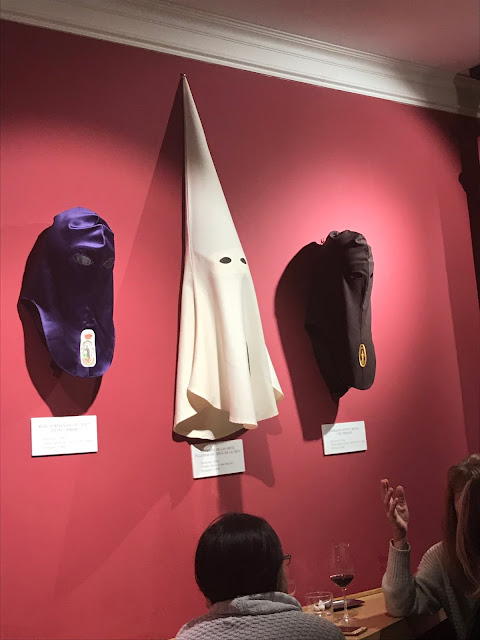
Some of the hoods of the religious Brotherhoods on the wall at Ezequiel.  The center hood is from the Brotherhood of the Seven Words of Christ on the Cross.  I will wear a hood like this in two processions, one on Wednesday, and another on Good Friday.  (You can click on images in this blog for a larger view.  Hit the "Escape" or "esc" key to return to a normal view.)


More hoods of the various Brotherhoods.

My mother-in-law, María Rosa, showed me her framed display of the habits and hoods worn by the various Brotherhoods in León. Each Brotherhood has its own papon (habit and hood).  The styles are traditional from the middle ages.


This should give you a better idea of what a procession looks like.  Again, this the the Brotherhood of the Seven Words of Christ on the Cross. (2016)

After leaving Ezequiel, we went to another restaurant, La Taberna for glasses of wine and  big bowls of garbanzo soup as the tapas.  Before I had finished my wine and soup, one of the members of my party told me that Eduardo was in the back of the bar.  I was surprised to run into him on my first full day in León, but there he was with other members of his Brotherhood. While I didn't ask, they were obviously planning for the Holy Week ahead, but Eduardo stood and greeted me with great affection.  He explained that if I was willing, I would participate in two processions, on Wednesday night marching, and on the night of Good Friday helping to carry one of the pasos (giant religious floats) in the procession.  This is a great honor to which I'm looking forward.

I (right) ran into Eduardo de Paz (left) by chance on a tapas outing my first full day in León. Several months ago, Eduardo invited me to participate in the processions of the Brotherhood of the Seven Words of Christ on the Cross.

When I was here two years ago, I did an interview with Eduardo, then 81, about the significance of the processions.  Rather than making you click on a link to get to it, I'm repeating the blog entry below in it's entirety because if you're not familiar with the processions, their origins, and history, I believe it will lay the groundwork for a better understanding of some of the blog posts to come.


⃟⃟⃟⃟       ⃟⃟⃟⃟       ⃟⃟⃟⃟


The Holy Week Processions of León -- Faith and Optimism for the Future 
(originally published March 23, 2016: two years ago today)

At 81 years of age, Eduardo de Paz is known as a gentleman of quiet and profound faith.  The twelve brotherhoods he serves respect him as a leader, a source of knowledge, wisdom, and strength.  Over the years, he has witnessed decades of change: sometimes for better, sometimes worse.  


 Eduardo de Paz has been a member of the religious brotherhoods of Spain for 69 years.  He is a member of six brotherhoods in León, two in Malaga, two in Seville, one in Madrid and one in Saragosa.  He founded one of the most important brotherhoods in 1962. (You can click on photos in this blog for a larger view.)


“We are now in a bad time,” he says.  “There is a lack of religion.” 

Then, just as quickly, he expresses optimism. “In time, people will be more involved,” he pronounces.  “Of that, I am certain.”  He explains that the processions he has been a part of since the age of 12 are tools for teaching.  In centuries past, the gigantic religious floats (pasos) portraying the Biblical story of death and resurrection were the media of their time.  They told the story of Easter in a way that mere words could never express.  Today, he says, they continue to serve the same purpose.  They create an excitement and inspire people to participate; they introduce people to the brotherhoods and traditions.

Many hours are spent preparing, cleaning, repairing, and assembling pasos (floats) for the processions.


Those who become members of the brotherhoods treasure the experience.  A father often registers his son into the brotherhood upon his birth.  One of Eduardo’s son’s, Eduardo has achieved the honor of Hermano de Oro (Brother of Gold) for 50 years in the brotherhood.  The other son, José Luis will achieve the honor next year when he turns 50, also having a half century in the brotherhood.

 Eduardo's grandson, Jorge de Paz helps his grandfather into the robes that are unique to his brotherhood. Jorge was registered into the brotherhood upon his birth by his father, José Luis.


Eduardo poses in front of the Basilica of San Isodoro with Gonzalo González Cayón, the Abad (President) of another brotherhood, founded in 1572.


Eduardo, who founded the Cofradía de las Siete Palabras de Jesús en la Cruz (Brotherhood of the Seven Words of Jesus on the Cross) in 1962, says that the people of León take the processions very seriously.  Almost every family will have someone involved.  Thousands, young and old, men and women, will march in the processions. Those who participate will not only help bear a float or play a musical instrument, they will also have an opportunity to pray and become more involved in religion.  Spectators, too, continue to be drawn to the spectacle of a procession, with some drawing tens of thousands of onlookers.  Holy Week is the busiest time of the year in León.

 This paso being prepared for a procession is dedicated to Eduardo, who was the first Abad (President) of his brotherhood. He remain an honorary Abad.

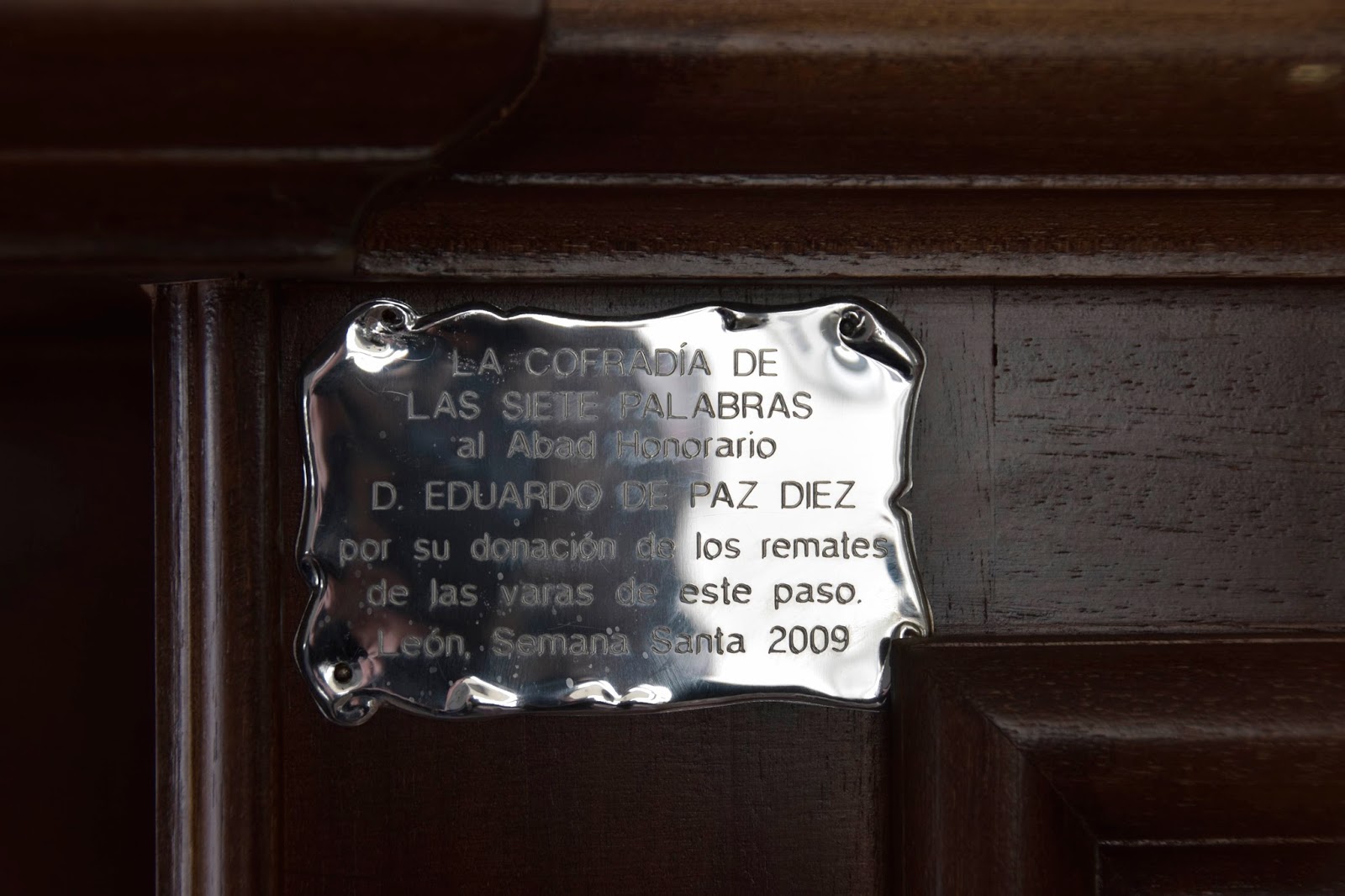
A plaque on the processions honors Eduardo for his service to the brotherhood.


Eduardo explains that the processions of Malaga and Seville are flashier, with many pasos displaying an excess of Baroque gilding, silver, and embellishments. Maybe, he says, this is why the processions of the South are better known. In the North, he declares, people are more serious and tend to favor less ornate pasos.  While still having its share of golden platforms and ostentation, the pasos of León are just as often made of beautifully carved wood without the excess of ornamentation.

Thirty-six processions are conducted over the ten days of la Semana Santa (Holy Week), some small with only a few hundred participants, others huge with many thousands actively involved.  When I asked Eduardo about the future, he was as optimistic as ever.  While the brotherhoods and processions evolve to meet the needs of their times, he does not see a time when processions will not continue to serve the faithful.  

A moonlight procession much as it might have looked one hundred years ago, and as it may appear one hundred years from now.


When I asked Eduardo if processions will still be flourishing in 100 years, he responded, “Certainly!”


I will continue reporting on Holy Week in León as the week progresses.

You can view my website at:  www.tombellart.com.

I will be blogging about Holy Week and much more during the upcoming days.  Please subscribe to my blog by clicking here is you would like to be updated when there is something new.


This blog has been named one of the top 75 fine art photography blogs on the planet.


Thursday, March 8, 2018

Being There: Easter is Coming -- So, I'm Going to Spain...

I have been honored in a way that few Americans might understand.

I've been invited to march in one of Spain's traditional (and amazing) Holy Week processions.  To put it in perspective, for me, this is akin to Eliza being invited to the ball.

But I will participate fully so as to gain knowledge and understanding that can only be achieved through, as Peter Sellers playing Chance Gardner might refer to, as "being there."


I photographed most of the Holy Week processions in León, Spain in 2016.  I will be in León again this year for Easter, not only to photograph these amazing demonstrations of devotion, but also to participate. This is one of the major processions, organized by the Brotherhood of the Seven Words of Christ on the Cross.  It is with this Brotherhood that I have been invited to participate.


I have been both a reporter and photographer at many happenings and events in the United States and throughout the world.  However, viewing an event through a lens or interviewing others about their participation is not the same as experiencing it for yourself.

The Processions start on Friday the week before Easter, with as many as seven processions in a single day, everything ending on Easter Sunday.  They are sponsored by Catholic Brotherhoods, many of them centuries old. The processions take place both night and day.  The robes and hoods date back to the the medieval period.  Hoods were originally worn to protect the identity of the penitents as they carried the heavy religious floats (pasos) on their shoulders.  In this manner, only God would know their identity.


Just as Ernest Hemingway often gained knowledge of what he wrote about by being actively involved (such as volunteering to drive an ambulance in the Spanish Civil War), I hope that changing my viewpoint from that of by-stander to active participant will allow me to gain a much deeper understanding of the processions and what it means to march along directly with the members of a Brotherhood.


Some of those carrying the paso show their devotion to penance by walking the many miles and hours of the procession barefoot, just as my wife's grandfather did almost a century ago.


I will be blogging throughout Holy Week, hopefully with new insight into the processions and rituals, but also about tapas, and more!  If you want a reminder every time I put out a new post, click here and submit your email adddress.  Also, please feel free to post comments.


Tapas are one of my favorite subjects to blog about, so not only will you be getting religion, but also, food!


You can view my website at:  http://www.tombellart.com.

You can subscribe to this blog by clicking here and entering your email address.  You will be notified when a new entry is posted.

This blog has been named one of the top 75 fine art photography blogs on the planet.