Showing posts with label Europe. Show all posts

Wednesday, April 18, 2018

Road Trip: Astorga!

Despite the fact that I'm back in Illinois and largely recovered from the 32-hour trip from León, Spain to my home, I still want to share my road trip to Astorga.

It's a small and ancient town with both Celtic and Roman origins.  Only about 30 miles from León, Astorga is an important stop on the Camino de Santiago (the Way of St. James.)  I drove my mother-in-law's mint-condition 1982 Mercedes 300D, and was there in less than an hour.


1982 Mercedes 300D.  A great car for a road trip.  I first drove this car in 1995 when it was only 13 years-old.  It still looks like a new car.


Famous for it's sweet pastries, called Mantecadas, Astorga is probably best known for its Bishop's Palace, designed by Antoni Gaudí and built between 1889 and 1913. I strongly recommend that you find time to walk through the town's center, but if you only have time for one thing, the Bishop's Palace is the place to see.

Mantecadas are served with coffee at the hotel cafe across the street from the Cathedral and the Bishop's Palace.
Wall art shows the packing of Mantecadas cakes in earlier days.
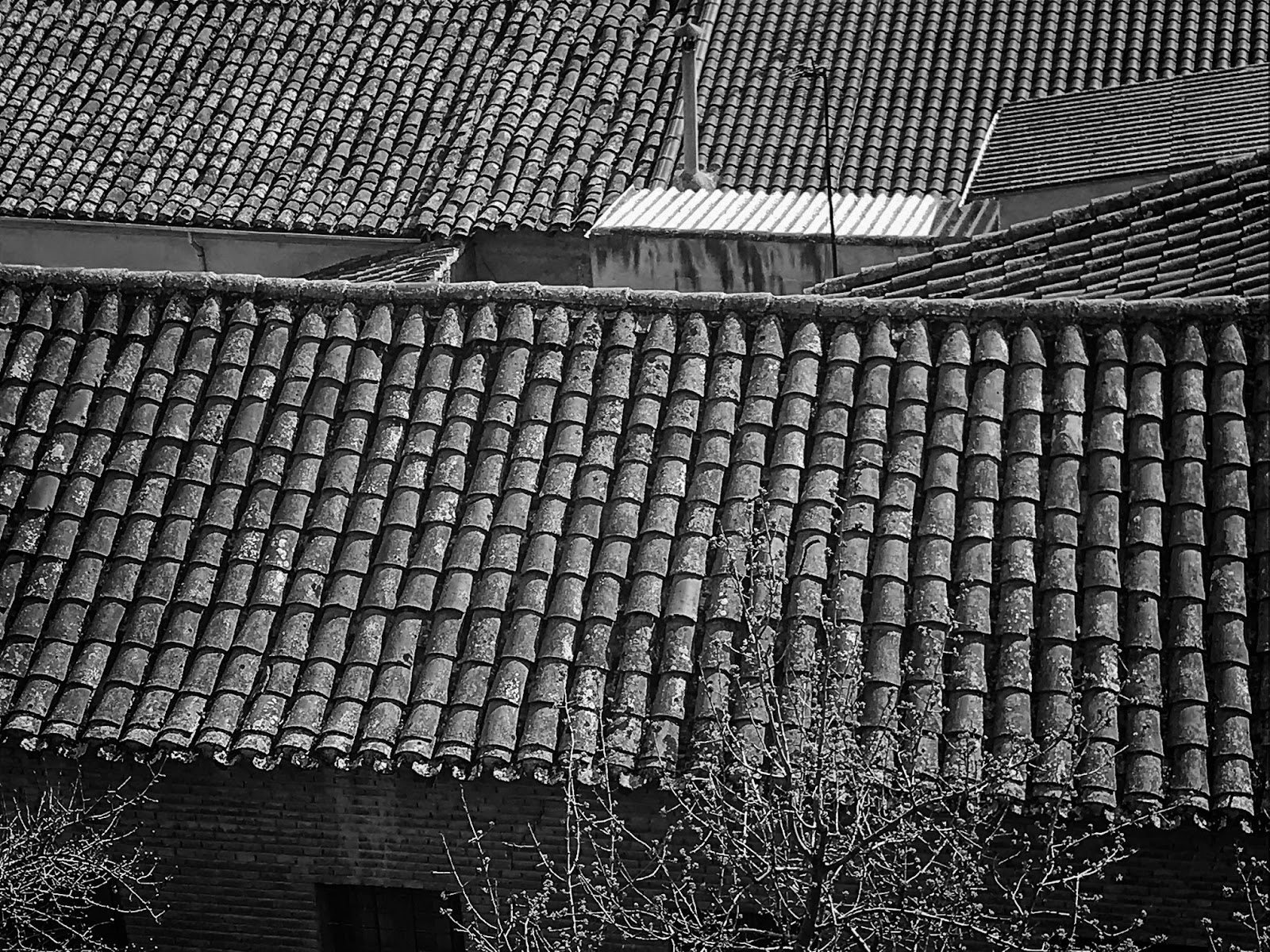
Tile Roofs from an overlook in Astorga.


The municipal building in Astorga
Me in front of the entrance to the Bishop's Palace. The building is in the neo-Gothic style. (Photo by my mother-in-law.)
Exterior view of the Bishop's Palace. I can imagine it as a set from the Wizard of Oz.

Stained glass detail from the Bishop's Palace.
More stained glass.
Painted ceramic tiles highlight arches throughout the palace.

More stained glass and ceramic tile.
The chapel in the Bishop's palace.

Wide shot of the Palace.


I hope you've enjoyed this brief road trip to Astorga.  I will have more from Spain in upcoming posts. If you would like to follow along and receive a notification when a new post appears, please subscribe by clicking here and entering your email address.

You can view my fine art photography website at:  www.tombellart.com.


This blog has been named one of the top 75 fine art photography blogs on the planet.

Sunday, March 25, 2018

The Procession of Jesus of Hope

I left you yesterday with a cliffhanger.  It rained and snowed most of the day, threatening the five processions scheduled for Passion Saturday (sábado de pasión.)  However, at about 4:00 p.m. the sun came out, and everything was dry by 6:00 p.m., the beginning of the Procession of Jesus of Hope  (Procesión de Jesús de la Esperanza.) This is the procession I chose to attend on Saturday.  I was told it was a rather small procession, but judging from the hundreds of participants and thousands of spectators, I'm not convinced.

As I write this, it is Palm Sunday and I'm not going to spend a lot of time writing today.  Instead, I will share photographs from last night's procession.  I hope you get a feel for the sights and sounds of the event.

"Sounds?" you ask. You're sharing photographs.

Yes, but I thought I'd also throw in a short video clip.  Along with the photographs, it might give you a better understanding of some of the things I mention. Don't worry, it's less than a minute.  (You can click on the little square on the bottom right of the screen to get a full screen view.  Hit the "esc" key to return to normal.)

The procession moves through the Plaza of the Chrurch of San Isidoro.  Many believe that the actual Holy Grail resides inside the church's museum.


This paso is relatively new. It was created in 2012, proving that the centuries-old tradition of creating objects of devotion continues.  You can click on photos in the blog for a closer view.  To return to a normal view, click the "escape" or "esc" key.


Hooded penitents, known as papones, carry another of the pasos.  This paso is from the late 20th centruy.  Several of the penitents walk barefoot to demonstrate their devotion.
A closer view.
Music is an important part of most processions.
A boy carries incense

Women and children have been participating in most of the processions for decades.
Processions last several hours and can take their toll on both young and old.
Children pass out candy along the route.
This paso showing the Virgin Mary holding her crucified son dates from the sixteenth century.


Detail from the 16th century sculpture.
I estimate that tens of thousands of spectators viewed this procession.
I will continue reporting on Holy Week in León as the week progresses.

You can view my website at:  www.tombellart.com.

I will be blogging about Holy Week and much more during the upcoming days.  Please subscribe to my blog by clicking here is you would like to be updated when there is something new.


This blog has been named one of the top 75 fine art photography blogs on the planet.


Friday, March 23, 2018

Keeping Traditions Alive: Holy Week in León, Spain

Last night, I was out with family and friends, doing what many in León do during the evening.  We were enjoying drinks and tapas in the barrio húmedo (drinking district).  Our first stop was Ezequiel, a restaurant/bar on the main street of the city that specializes in Spanish ham, chorizo, and other fine Spanish meats.

Ezequiel keeps Holy Week alive all year long by displaying on its walls the hoods of the various religious brotherhoods that sponsor the Easter processions.  At the invitation of Eduardo de Paz, I will participate in two processions during Holy Week.  Eduardo is one of the prime figures in organizing the processions, and is the founder of the Brotherhood of the Seven Words of Christ on the Cross.
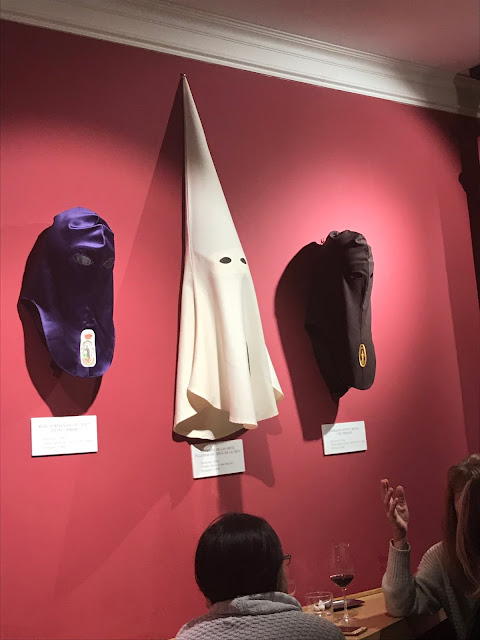
Some of the hoods of the religious Brotherhoods on the wall at Ezequiel.  The center hood is from the Brotherhood of the Seven Words of Christ on the Cross.  I will wear a hood like this in two processions, one on Wednesday, and another on Good Friday.  (You can click on images in this blog for a larger view.  Hit the "Escape" or "esc" key to return to a normal view.)


More hoods of the various Brotherhoods.

My mother-in-law, María Rosa, showed me her framed display of the habits and hoods worn by the various Brotherhoods in León. Each Brotherhood has its own papon (habit and hood).  The styles are traditional from the middle ages.


This should give you a better idea of what a procession looks like.  Again, this the the Brotherhood of the Seven Words of Christ on the Cross. (2016)

After leaving Ezequiel, we went to another restaurant, La Taberna for glasses of wine and  big bowls of garbanzo soup as the tapas.  Before I had finished my wine and soup, one of the members of my party told me that Eduardo was in the back of the bar.  I was surprised to run into him on my first full day in León, but there he was with other members of his Brotherhood. While I didn't ask, they were obviously planning for the Holy Week ahead, but Eduardo stood and greeted me with great affection.  He explained that if I was willing, I would participate in two processions, on Wednesday night marching, and on the night of Good Friday helping to carry one of the pasos (giant religious floats) in the procession.  This is a great honor to which I'm looking forward.

I (right) ran into Eduardo de Paz (left) by chance on a tapas outing my first full day in León. Several months ago, Eduardo invited me to participate in the processions of the Brotherhood of the Seven Words of Christ on the Cross.

When I was here two years ago, I did an interview with Eduardo, then 81, about the significance of the processions.  Rather than making you click on a link to get to it, I'm repeating the blog entry below in it's entirety because if you're not familiar with the processions, their origins, and history, I believe it will lay the groundwork for a better understanding of some of the blog posts to come.


⃟⃟⃟⃟       ⃟⃟⃟⃟       ⃟⃟⃟⃟


The Holy Week Processions of León -- Faith and Optimism for the Future 
(originally published March 23, 2016: two years ago today)

At 81 years of age, Eduardo de Paz is known as a gentleman of quiet and profound faith.  The twelve brotherhoods he serves respect him as a leader, a source of knowledge, wisdom, and strength.  Over the years, he has witnessed decades of change: sometimes for better, sometimes worse.  


 Eduardo de Paz has been a member of the religious brotherhoods of Spain for 69 years.  He is a member of six brotherhoods in León, two in Malaga, two in Seville, one in Madrid and one in Saragosa.  He founded one of the most important brotherhoods in 1962. (You can click on photos in this blog for a larger view.)


“We are now in a bad time,” he says.  “There is a lack of religion.” 

Then, just as quickly, he expresses optimism. “In time, people will be more involved,” he pronounces.  “Of that, I am certain.”  He explains that the processions he has been a part of since the age of 12 are tools for teaching.  In centuries past, the gigantic religious floats (pasos) portraying the Biblical story of death and resurrection were the media of their time.  They told the story of Easter in a way that mere words could never express.  Today, he says, they continue to serve the same purpose.  They create an excitement and inspire people to participate; they introduce people to the brotherhoods and traditions.

Many hours are spent preparing, cleaning, repairing, and assembling pasos (floats) for the processions.


Those who become members of the brotherhoods treasure the experience.  A father often registers his son into the brotherhood upon his birth.  One of Eduardo’s son’s, Eduardo has achieved the honor of Hermano de Oro (Brother of Gold) for 50 years in the brotherhood.  The other son, José Luis will achieve the honor next year when he turns 50, also having a half century in the brotherhood.

 Eduardo's grandson, Jorge de Paz helps his grandfather into the robes that are unique to his brotherhood. Jorge was registered into the brotherhood upon his birth by his father, José Luis.


Eduardo poses in front of the Basilica of San Isodoro with Gonzalo González Cayón, the Abad (President) of another brotherhood, founded in 1572.


Eduardo, who founded the Cofradía de las Siete Palabras de Jesús en la Cruz (Brotherhood of the Seven Words of Jesus on the Cross) in 1962, says that the people of León take the processions very seriously.  Almost every family will have someone involved.  Thousands, young and old, men and women, will march in the processions. Those who participate will not only help bear a float or play a musical instrument, they will also have an opportunity to pray and become more involved in religion.  Spectators, too, continue to be drawn to the spectacle of a procession, with some drawing tens of thousands of onlookers.  Holy Week is the busiest time of the year in León.

 This paso being prepared for a procession is dedicated to Eduardo, who was the first Abad (President) of his brotherhood. He remain an honorary Abad.

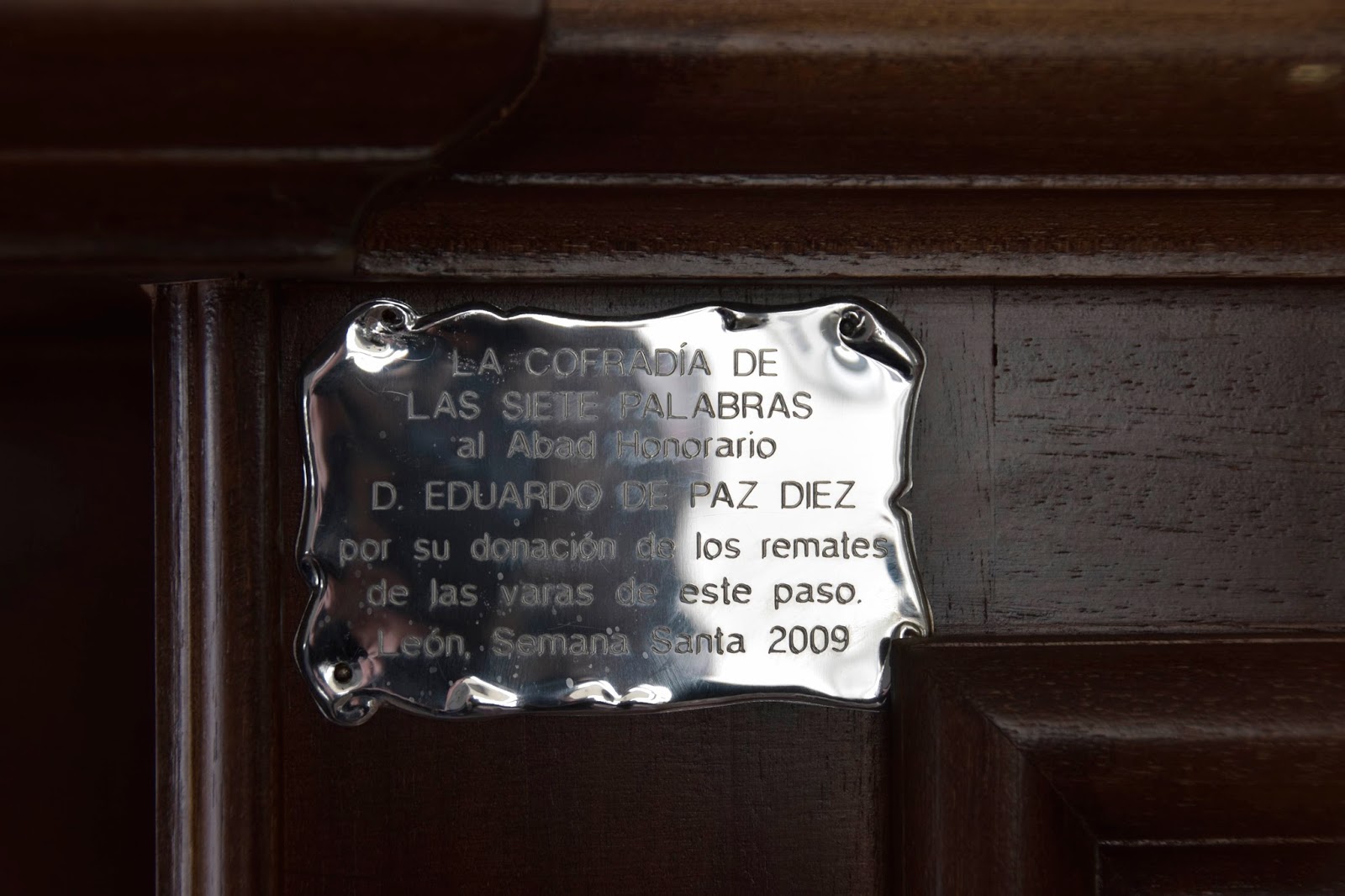
A plaque on the processions honors Eduardo for his service to the brotherhood.


Eduardo explains that the processions of Malaga and Seville are flashier, with many pasos displaying an excess of Baroque gilding, silver, and embellishments. Maybe, he says, this is why the processions of the South are better known. In the North, he declares, people are more serious and tend to favor less ornate pasos.  While still having its share of golden platforms and ostentation, the pasos of León are just as often made of beautifully carved wood without the excess of ornamentation.

Thirty-six processions are conducted over the ten days of la Semana Santa (Holy Week), some small with only a few hundred participants, others huge with many thousands actively involved.  When I asked Eduardo about the future, he was as optimistic as ever.  While the brotherhoods and processions evolve to meet the needs of their times, he does not see a time when processions will not continue to serve the faithful.  

A moonlight procession much as it might have looked one hundred years ago, and as it may appear one hundred years from now.


When I asked Eduardo if processions will still be flourishing in 100 years, he responded, “Certainly!”


I will continue reporting on Holy Week in León as the week progresses.

You can view my website at:  www.tombellart.com.

I will be blogging about Holy Week and much more during the upcoming days.  Please subscribe to my blog by clicking here is you would like to be updated when there is something new.


This blog has been named one of the top 75 fine art photography blogs on the planet.


Wednesday, March 21, 2018

Good Timing and Blue Skies Are Good Signs for Easter

I arrived in Madrid yesterday morning.  I flew in from Chicago. My mother-in-law, María Rosa, flew in from Guatemala.  However, our timing was excellent! 

Despite the size of Madrid's Barajas airport, despite the large crowd going through baggage pickup and customs, my mother-in-law was the first person I saw as the automatic door to Luggage Carousels One through Six slid open.  She had already retrieved her suitcases, and within a couple of minutes, I had mine.  Two years ago when I came for Easter, it was the same; she was among the first I saw when I entered the luggage area.  She had been scheduled to arrive a couple of hours before me, but various delays put us together at the most opportune time.

It could have been worse, I assure you, much worse.

Had I chosen to go on the same flight  one day earlier, it would have been a disaster.  My plane was scheduled to depart for Madrid at 5:30 p.m.  However, I arrived at Chicago's O'Hare Airport at about 10 a.m.  I was surprised that there were about a hundred travelers in line before me and the airline desk hadn't even opened yet. An employee of the airline told me that these were passengers from the previous day's flight, which had been cancelled due to mechanical problems.  She suggested it would be quite a while before passengers for today's flight would be served, and that I might enjoy waiting in the Starbuck's on the lower level.  When I returned an hour later, there were a couple of hundred more people waiting in line, and there was still no one at the counter to serve them.  As I watched, more and more people kept arriving and the line kept getting longer and longer.

Passengers of a delayed flight that I was fortunate not to be on. (You can click on photos in this blog for a larger view.  On a full size computer hit the "Escape" or "esc" key to exit full size.)
To make a long story short, when I finally went through the security gates after 3:00 p.m., those passengers from yesterday's flight were still waiting.  Before I boarded my on-time flight, I heard someone say that parts for the plane still hadn't arrived and that the poor passengers would be delayed for a second day.  I felt very fortunate, indeed, not to have chosen to leave a day earlier.

María Rosa and I took a bus from Madrid to León, in the north of Spain, where she has an apartment.  Since I didn't sleep on the plane, my moments of consciousness during the five hours on the bus were few.  However, at one moment, I awakened to look out the window and see that we were surrounded by recently-fallen snow.

A view out the bus window somewhere between Madrid and León.
We arrived in León just before 4:00 p.m.  I opened my eyes just before we pulled into the bus station, and was surprised to see sunshine and clear streets.  For me it was a promising sign that the weather might hold out for the upcoming Easter processions, which can easily be cancelled because of inclement weather.  As I was planning my trip, most of the extended forecasts had called for snow or rain in León.

This is the view from my mother-in-law's apartment window last night.  Note the crescent moon and the clear skies.

The same view of the Plaza de la Inmaculada this morning.  The skies are blue and the temperature is 41 degrees F. (5.5 degrees C.).
The extended forecasts still calls for rain and even more snow over the next few days, but this isn't stopping the people here from preparing for the amazing Holy Week processions that occur the ten days leading up to Easter.

A Legos model of a Holy Week procession in a shop window near my mother-in-law's apartment is a tradition in León. The scene changes from year to year.  The shop was closed when I went by in the early afternoon, and the shop lights above the display were not lit.  I'll return for better photos when the lighting is better.
A closeup of the window scene.

I'll also be writing more about food and the amazing tapas here in León.  The city has been named: Capital Española de la Gastronomía 2018."  Or in English: 2018 Gastronomic Capital of Spain. (See my post from October of 2017). It's only my first full day in León, but that hasn't stopped me from having a drink and trying out some tapas.


These tapas of toasted bread, cheese, meat and other toppings served at the Cambalache restaurant are typical of what you might get when you order a drink.
This baked ravioli is another of the tapas at the Cambalache.
This red wine is a Rioja.  Rioja is one of the great wine producing regions of Spain.  If you order a glass like this, the cost is only about 1 Euro ($1.25), and you get a tasty appetizer (tapas) like those above at no additional cost.
As I said, I'm hoping that good timing and blue skies are good signs, but come rain or shine, I'll be blogging about Holy Week, tapas, and much more over the next three weeks.  If you don't want to miss any of my blog entries, please enter your email to subscribe to my blog.  You will automatically be updated when I post something new.  Also, feel free to make comments below.

You can view my fine art photography website at:  www.tombellart.com.


This blog has been named one of the top 75 fine art photography blogs on the planet.