Sunday, March 27, 2016

Easter in León

This is the sixth in a series of posts on Holy Week in León, Spain.  While Easter Sunday ends the processions and celebrations,  I will have additional photographs and commentary in upcoming posts.

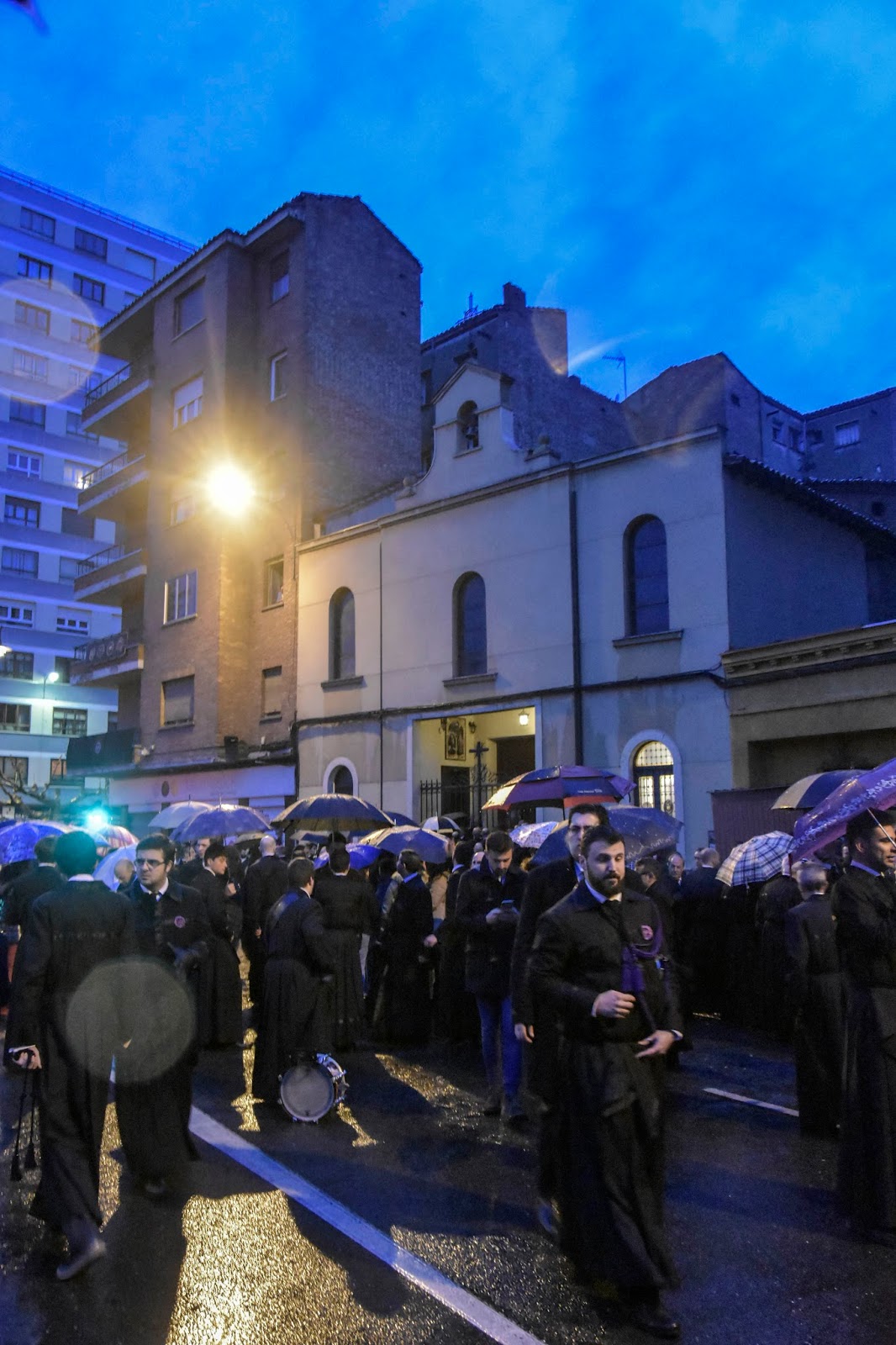
Holy Saturday ended with rain, leaving only the first of the three scheduled Saturday processions to proceed. In The Procession of Santo Cristo Desenclavado,  the dead Jesus is removed from the cross and finds his place in the arms of his Mother, the Virgin Mary.


Christ is removed from the Cross on the paso, preparing the way for is burial and subsequent resurrection.
(You can click on photographs for a larger view.)
A sculpture of Christ in the Arms of his Mother replaces Christ on the Cross.
Easter morning is clear, despite rain that was predicted earlier.  The final procession starts with participants wearing their hoods (capirotes) as they somberly march. 


Hoods, which allow participants to repent in anonymity are no longer needed upon word that Christ has risen.  The rest of the procession takes place without the facial coverings.


Young people are an important part of the Easter celebration.  Here, sisters Irene, age 8 (front), Paula, age 10, and Mónica, age 5, greet spectators lining the path of the procession.  They are veterans of previous processions here in León and continue a family tradition that goes back generations.

Easter comes with the rising of Christ from the tomb.

The final paso portrays the Virgin Mary wearing a Crown of Glory.  In her right hand is a scepter, which replaces a handkerchief that she had carried before.  Tears and sorrow are replaced with joy.
 
The Virgin Mary is seen as Reina de los Cielos (Queen of Heaven).

I hope you've enjoyed my coverage of Semana Santa (Holy Week) here in León.  There will be more photographs in upcoming blog posts.  I'll also have more posts on food, drink, culture, and other adventures.

Happy Easter to All.

If you would like to view the five other parts of this series, they can be found here:

Part 1: Preparing for Easter Week (Semana Santa) in León, Spain – An Unexpected Surprise of Tradition, Legos, Family, Pharmaceuticals, Food & Drink
 
Part 2: Holy Week in León -- Family, Tradition & Food
 
Part 3:  The Holy Week Processions of León -- Faith and Optimism for the Future
 
Part 4:  Procession of the Pasos: Twenty Photographs to Help You Understand Holy Week in León on This Good Friday

Part 5:  Holy Week in León: The Seven Words of Jesus on the Cross
 
You can view my website at www.tombellart.com.


Saturday, March 26, 2016

Holy Week in León: The Seven Words of Jesus on the Cross

 
This is the fifth in a series of posts on Holy Week in León, Spain.  I'll have more information and photographs in subsequent posts.

I attended two of  the three major religious procession on Good Friday.  It's impossible to attend all three unless you cut one short, as the last two take place at the same time.  Yesterday I reported on the Procession of the Pasos. Later in the day came the Procession of The Seven Words of Jesus on the Cross. This procession is conducted by the Brotherhood of The Seven Words of Jesus on the Cross.  In the days before the procession, I monitored the progress, as volunteers and members of the brotherhood assembled, cleaned, repaired and decorated the pasos (floats).  It is a major endeavor and takes a great deal of planning, coordination, and labor.


Members of the Brotherhood and city officials proclaim the upcoming procession from the balcony of city hall on the Thursday before the event.
(You can click on photographs in this blog for a closer view.)

 
León's mayor (farthest on the balcony) and other officials speak as members of the Brotherhood, some mounted on horses, and the public gather in the plaza below to hear the proclamation.


Horse-mounted riders lead the procession on Good Friday. 
 
There is no paso (float) for the first words of Jesus on the cross.  A banner simply proclaims:
"Father, forgive them, for they do not know what they do."
Gospel of Luke 23:34


The first paso proclaims the second words Jesus spoke:
"Today you will be with me in Paradise."
Gospel of Luke 23:43


Paso of the Third Word


"Jesus said to his mother: "Woman, this is your son."
Then he said to the disciple: "This is your mother."
Gospel of John 19:26-27


The Fourth Word
"My God, my God, why have you forsaken me?"
Matthew 27:46 and Mark 15:34
 
Detail from The Fourth Word

 
The Fifth Word
"I thirst."
Gospel of John 19:28

Detail from The Fifth Word.  Flowers are an important element to all of the pasos.


The Sixth Word:
"It is finished."
Gospel of John 19:30


Closer view of The Sixth Word.
 
Detail from The Sixth Word.
 
By the time the Paso of the Seventh Word passes San Isidoro it is turning dark.


 The Seventh Word:
"Father, into your hands I commend my spirit."
Gospel of Luke 23:46
 
 
I think this very focused post is fitting leading into Easter Sunday.  In six pasos it gives a visual representation of the entire Passion on the Cross. 
 
If you would like to view the other parts of this series, they can be found here:
 
Part 1: Preparing for Easter Week (Semana Santa) in León, Spain – An Unexpected Surprise of Tradition, Legos, Family, Pharmaceuticals, Food & Drink
 
Part 2: Holy Wee k in León -- Family, Tradition & Food
 
Part 3:  The Holy Week Processions of León -- Faith and Optimism for the Future
 
Part 4:  Procession of the Pasos: Twenty Photographs to Help You Understand Holy Week in León on This Good Friday
 
 
You can view my website at www.tombellart.com.


Friday, March 25, 2016

Procession of the Pasos: Twenty Photographs to Help You Understand Holy Week in León on This Good Friday

This is the fourth in a series of posts on Holy Week in León, Spain.  I'll have more information and photographs in subsequent posts.

Most Americans (and other nationalities) know little of the massive preparations and elaborate expressions of faith that define Holy Week (Semana Santa) in Spain.  Those who are aware probably know about the grand processions of Seville, Granada, or Malaga.  Just as important, but lesser known, are the processions in the northern city of León where I'm spending Holy Week.  The biggest procession in León is a daytime event on Good Friday, with twelve massive pasos (floats).   It's called The Procession of Pasos.
 
 
The procession was scheduled to leave the church of Santa Nonia at 7:15 in the morning.  A light and steady rain seemed ready to end it before it started.  The pasos (floats) cannot be exposed to even moderate moisture because of the damage it causes to the wood.  Some of the pasos carried during Holy Week are national treasures that date to the 1500s.


After a delay of an hour, the first pasos left Santa Nonia.  The Procession of the Pasos has been in León since 1611.  This is the Oration of Christ in the Garden and dates to 1952.


The Capture is another modern paso.  It was created in 1964.

Some of those carrying the paso show their devotion to penance by walking the many miles and hours of the procession barefoot.


Women have participated in most of the processions for decades.

The Flagellation.  The pasos passed in front of León's Gothic cathedral in addition to many other historic places. While starting in the early morning, the procession did not end until late afternoon.  This paso dates to the 16th century.
 
The Coronation.  Pasos in the processions have traditionally been used to visually represent the story of Christ's passion.

Ecce Homo dates to the early part of the 20th century.


The reverse of Ecce Homo.


Our Father Jesus of Nazareth dates to 1610.  My wife's family has participated in helping to bear this paso for generations.


A closer view of  Our Father Jesus of Nazareth.


Veronica dates to the 1920s.
The Exploiting has been in processions since 1675.
Detail from The Exploiting.  Dice lie atop Christ's robes. 

The Exaltation of the Cross is the newest of the pasos in the procession, from 2000.

The Crucifixion passed through the Plaza of San Isidoro, as did all the pasos.

A close-up of  The Crucifixion.

The Agony of Christ
 
Saint John is from 1946.
The Dolorosa shows the pain of the Virgin.  It is from 1949.
 
 
I hope my photographs and commentary help to give you a feel for Holy Week here in León.  If you would like to follow from the first post, click here.

Tomorrow, I'll be posting photographs and information about another of the great processions of
León:  The Seven Words of Jesus on the Cross.


You can view my website at: www.tombellart.com.


Wednesday, March 23, 2016

The Holy Week Processions of León -- Faith and Optimism for the Future

At 81 years of age, Eduardo de Paz is known as a gentleman of quiet and profound faith.  The twelve brotherhoods he serves respect him as a leader, a source of knowledge, wisdom, and strength.  Over the years, he has witnessed decades of change: sometimes for better, sometimes worse.  


 Eduardo de Paz has been a member of the religious brotherhoods of Spain for 69 years.  He is a member of six brotherhoods in León, two in Malaga, two in Seville, one in Madrid and one in Saragosa.  He founded one of the most important brotherhoods in 1962. (You can click on photos in this blog for a larger view.)


“We are now in a bad time,” he says.  “There is a lack of religion.” 

Then, just as quickly, he expresses optimism. “In time, people will be more involved,” he pronounces.  “Of that, I am certain.”  He explains that the processions he has been a part of since the age of 12 are tools for teaching.  In centuries past, the gigantic religious floats (pasos) portraying the Biblical story of death and resurrection were the media of their time.  They told the story of Easter in a way that mere words could never express.  Today, he says, they continue to serve the same purpose.  They create an excitement and inspire people to participate; they introduce people to the brotherhoods and traditions.

Many hours are spent preparing, cleaning, repairing, and assembling pasos (floats) for the processions.


Those who become members of the brotherhoods treasure the experience.  A father often registers his son into the brotherhood upon his birth.  One of Eduardo’s son’s, Eduardo has achieved the honor of Hermano de Oro (Brother of Gold) for 50 years in the brotherhood.  The other son, José Luis will achieve the honor next year when he turns 50, also having a half century in the brotherhood.

 Eduardo's grandson, Jorge de Paz helps his grandfather into the robes that are unique to his brotherhood. Jorge was registered into the brotherhood upon his birth by his father, José Luis.


Eduardo poses in front of the Basilica of San Isodoro with Gonzalo González Cayón, the Abad (President) of another brotherhood, founded in 1572.


Eduardo, who founded the Cofradía de las Siete Palabras de Jesús en la Cruz (Brotherhood of the Seven Words of Jesus on the Cross) in 1962, says that the people of León take the processions very seriously.  Almost every family will have someone involved.  Thousands, young and old, men and women, will march in the processions. Those who participate will not only help bear a float or play a musical instrument, they will also have an opportunity to pray and become more involved in religion.  Spectators, too, continue to be drawn to the spectacle of a procession, with some drawing tens of thousands of onlookers.  Holy Week is the busiest time of the year in León.

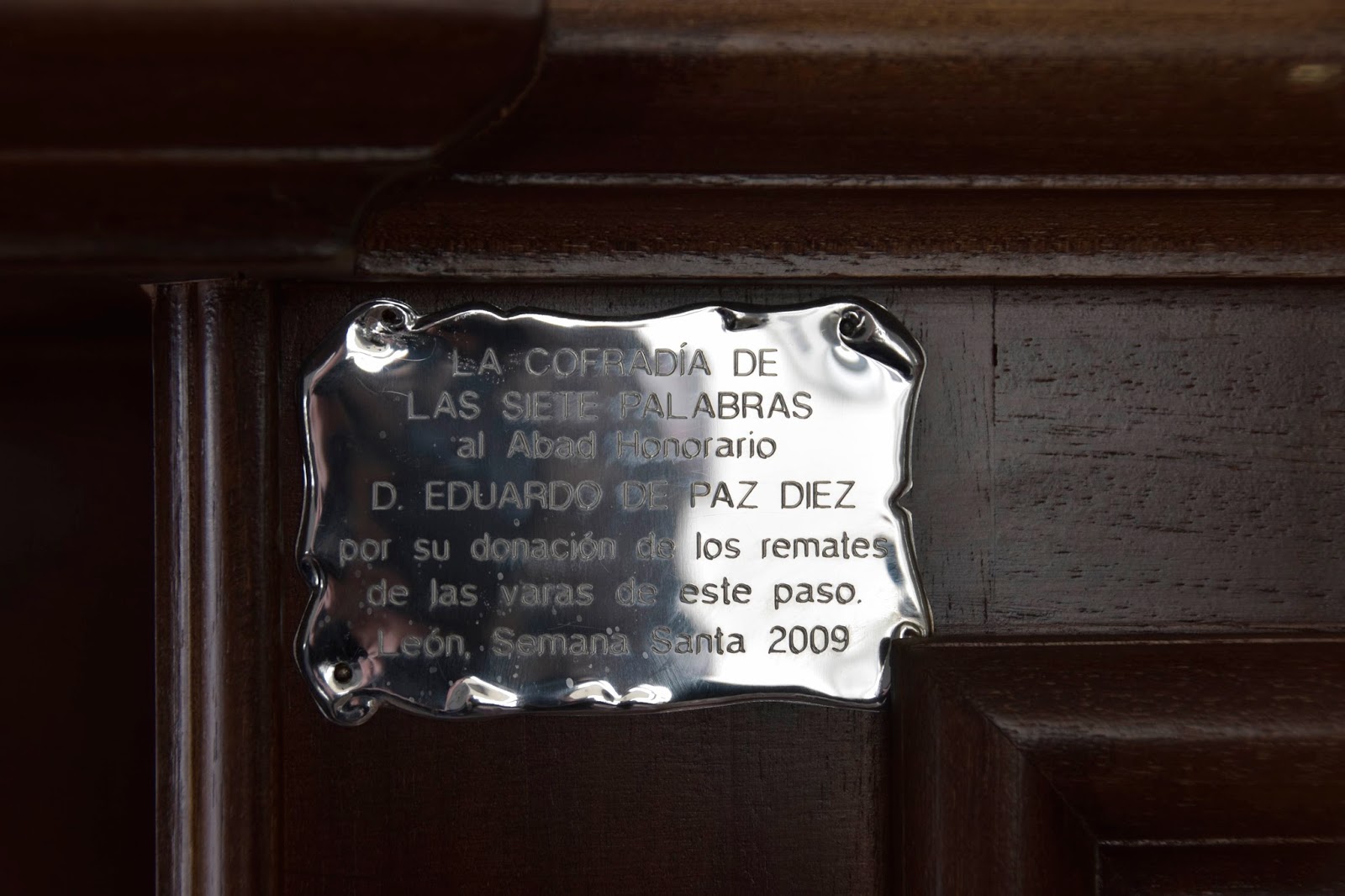
 This paso being prepared for a procession is dedicated to Eduardo, who was the first Abad (President) of his brotherhood. He remain an honorary Abad.

A plaque on the processions honors Eduardo for his service to the brotherhood.


Eduardo explains that the processions of Malaga and Seville are flashier, with many pasos displaying an excess of Baroque gilding, silver, and embellishments. Maybe, he says, this is why the processions of the South are better known. In the North, he declares, people are more serious and tend to favor less ornate pasos.  While still having its share of golden platforms and ostentation, the pasos of León are just as often made of beautifully carved wood without the excess of ornamentation.

Thirty-six processions are conducted over the ten days of la Semana Santa (Holy Week), some small with only a few hundred participants, others huge with many thousands actively involved.  When I asked Eduardo about the future, he was as optimistic as ever.  While the brotherhoods and processions evolve to meet the needs of their times, he does not see a time when processions will not continue to serve the faithful.  

A moonlight procession much as it might have looked one hundred years ago, and as it may appear one hundred years from now.


When I asked Eduardo if processions will still be flourishing in 100 years, he responded, “Certainly!”


I will continue reporting on Holy Week in León as the week progresses.

You can view my website at:  www.tombellart.com.